Cart
0
You may also like



People ask me all the time how I learned Hoodoo. They want a clean answer. A straight line. A book title. A teacher with a name and a lineage chart. They want me to say, “I studied under so-and-so,” or “I was initiated on this date,” as if the work comes stamped and certified like a document.
But the truth is simpler—and deeper.
We never openly talked about Hoodoo in my family when I was younger. There were no sit-down classes. No “this is how you lay a trick” lectures at the kitchen table. No dusty tomes hidden behind the cereal boxes. If you asked my grandmother about “conjure,” she would have looked at you like you were trying to invite trouble into the house with your mouth.
We were Baptist Christians. Period.
We went to church every Sunday. The choir, the sermons, the potlucks, the praying hands and the shouted amens—religion was stitched into our weekly rhythm like breath. To an outsider, we were just like every other family on our block. Nothing strange. Nothing mystical. Nothing suspicious.
And yet.
There were things in our home that did not come from Sunday School.
There were quiet actions that carried weight. A kind of knowing that did not need to be named to be real. The spiritual practices my elders trusted did not look like the flashy jar spells and elaborate altar “aesthetics” you see online today. You would have been lucky to see the trappings at all. The folk magic I grew up around was subtle—almost indistinguishable from Christianity unless you knew exactly what you were looking at.
That’s one of the first truths I learned about Hoodoo: real work doesn’t always announce itself. Real work moves like wind behind a curtain. It shifts the room without asking permission.
The tools of Hoodoo weren’t fancy. They weren’t expensive. They weren’t bought with the kind of money we didn’t have.
They were made from what lived around the house.
Scrap fabric. Old pots. Nails. Coins. Pins. A little string. A jar that used to hold something else. A paper bag folded just right. Things most people would throw away without thinking. Hoodoo has always known how to turn “trash” into power—because Hoodoo was built by people who had to survive while being told they were worth nothing.
Money was tight. So we recycled. We repurposed. We stretched things. My grandmother didn’t call it magic, but she absolutely understood that the world responded differently when you treated an object like it mattered. When you prayed over something. When you spoke Scripture into it. When you handled it with intention.
That’s how the work lived—inside ordinary life.
And it was kept quiet.
Charms were hidden, not displayed. Work was placed where it would have influence, not where it would be admired. Things were done silently in places of power and places of worship, because those places were spiritually “loud” already. If you didn’t know something was being done, you would never know where, when, or how the work had been applied.
That secrecy isn’t just tradition—it’s history.
I believe it comes from the need to keep spiritual work hidden from overseers during slavery. You don’t survive an empire with your rituals laid out in the open. And even now, long after those days, that instinct remains in the bones of the tradition: keep your power covered.
Another truth: Hoodoo is practical. It is regional. It is rooted in what is on hand.
The people who arrived in this new world did not have the resources to gather exotic ingredients. They didn’t have delivery services. They didn’t have the freedom to travel long distances just to find a plant they remembered from home. So the tradition adapted—because survival demanded adaptation.
That meant learning the land.
Learning what grows near you. Learning what blooms when. Learning what root sits under your feet. Learning the local ecosystem through observation, through seasons, through repetition. Where I grew up, there was an overgrown park not far from our house, and you could find bergamot, St. John’s Wort, calendula—plants with medicine in them, plants with spirit in them. We didn’t have the language of “correspondences” the way modern occult books explain it. We had something older: relationship.
You spend enough time around a plant, you learn what it does. You learn how it behaves. You learn what kind of spirit lives in it.
Our family spent a lot of time together, and we talked about God constantly. Looking back, I can see the way we talked about faith in our home wasn’t exactly how faith was talked about in church. It was more intimate. More immediate. Less polished.
The sun was a blessing.
Food was a blessing.
A quiet house was a blessing.
A healed body was a blessing.
We weren’t wealthy, but we were held together. The money we had went to bills and food, and everything in our home was simple. We made do. We didn’t have exotic herbs in pretty containers. I don’t remember ornate candles burning like something out of a catalog.
What I do remember is my grandmother’s Bible.
She held it like a weapon. And I mean that with full respect. That Bible was not a decoration. It was not just a book of stories. It was authority. It was protection. It was power.
I would see it laid flat on the kitchen table, opened to Psalms while food was being prepared, and even as a child I understood that something was happening. The atmosphere would shift. The room would feel held. The same way a storm feels different when you know the roof is solid.
I would see dimes dropped at the crossroads. If I asked why, I didn’t get an explanation. I got a look that said, “That isn’t for you to know.” And I knew better than to pry.
I would hear stories of healing—miraculous healing—done with prayer and faith. I would see my grandmother on her knees praying with a kind of passion that made me uncomfortable at first, because children can sense when something is too real for play.
And that’s the thing: Hoodoo was never framed as separate from religion. Not in my home. It was just…life. The healing ways of our ancestors were thought of as an extension of church. God created all things and gave each living thing its own power. So we worked with the gifts of the Earth—roots, stones, bones, leaves, flowers—while observing natural cycles the way farmers observe weather.
We didn’t reject science. We didn’t reject medicine. We didn’t romanticize suffering. If you needed a doctor, you went. If you needed prayer, you prayed. If you needed a wash, you washed. Survival is not a philosophy. It is a practice.
And in our house, spirituality was something you used, not something you performed.
Today, people see Hoodoo everywhere. Seven-day candles. Oils. Powders. Charms. Recipes. Prayers. Full workings openly displayed in storefronts and on social media. Everything is packaged, labeled, and simplified so it can be consumed quickly.
And don’t get me wrong—some of that visibility is good. It leads real seekers on a journey. It gives people a starting place. It helps folks remember that they have power and that the world is more than just the physical.
But in other ways, it’s a disservice.
Because simplified information without context creates hollow practice. It gives people instructions without worldview, and Hoodoo is not just a list of steps. Hoodoo is a way of seeing. It is a relationship with spirit, land, ancestors, and survival.
When you remove the context, you remove the roots. And without roots, the work becomes imitation—pretty, but unstable.
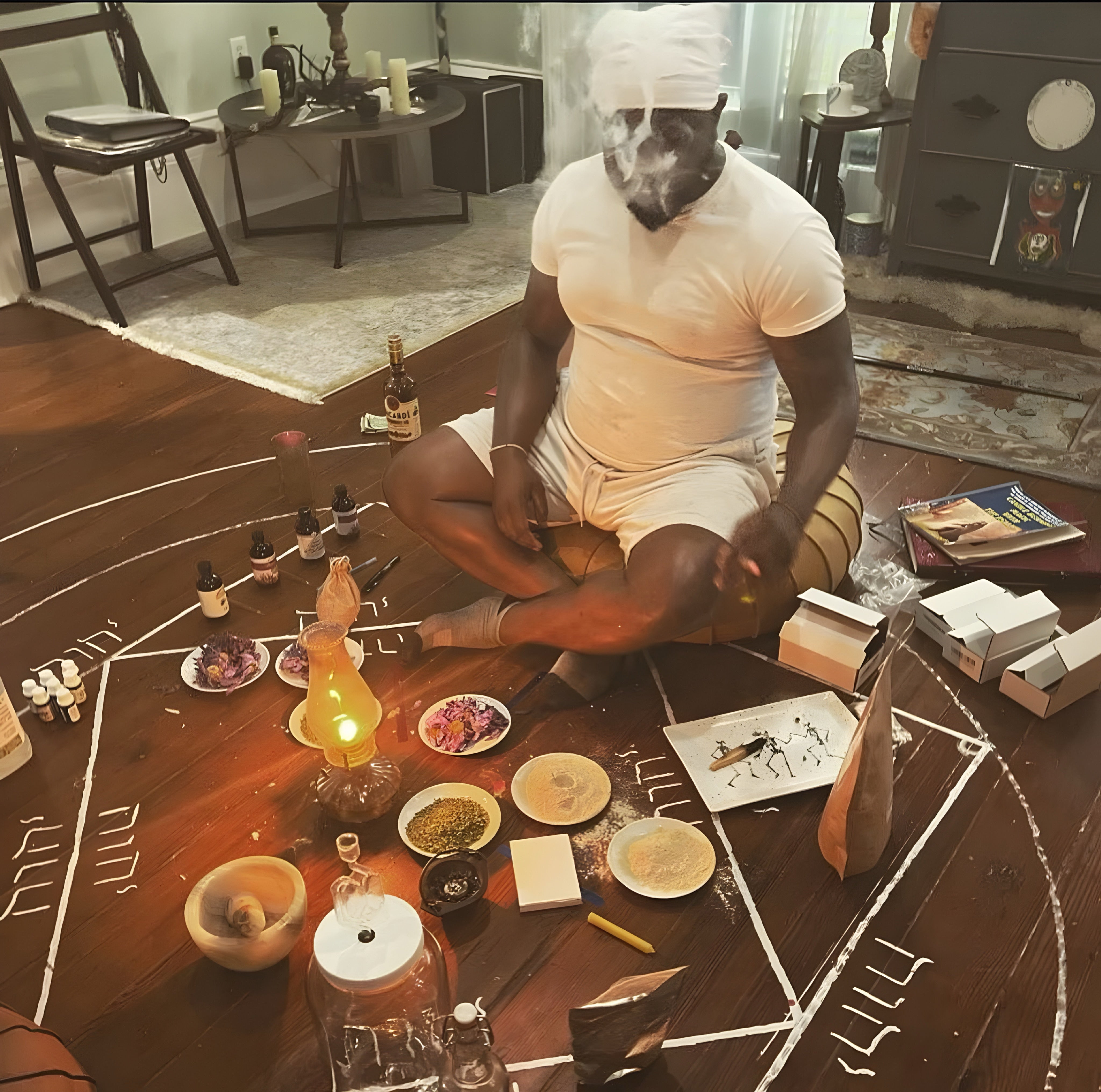
My perspective is not academic. It is lived. I am an African American man who carries this work as daily responsibility. I provide spiritual service. I provide counsel. I provide cleansing and correction and blessing. Not because it is trendy. Because it is necessary.
For me, Hoodoo looks like an old Black woman in her kitchen blessing the food. It looks like someone fighting for their family when arguments arise. It looks like real advice offered when somebody is about to ruin their own life out of pride or pain. It looks like the spirit of a household pulling people back into unity.
Before you go hunting for the perfect powder, understand that the root of the power lives in the people. Faith powers the work. Tears have been shed. Blood has been spilled. Lives have been lost. Solutions were discovered in that heat, and those solutions were carried forward by those who survived.
That’s the part the modern world often forgets.
There is a mountain of misinformation out there—disjointed pieces of “knowledge” passed around like gossip, contradicting itself from one platform to another. Learning has become a game of telephone, and with each retelling something important gets lost: the human reality that birthed this tradition.
Hoodoo is not the product of comfort.
It was born in pressure.
In fervent prayer and great pain, a power was seeded in the people—fueled by the need to survive at all costs, to overcome, to outlast, to protect what little they had, to reclaim joy and love and success in a land built to deny them those things.
They remembered the medicine of roots and herbs and minerals. They understood that the Earth still held power. They understood that Spirit still listened. And they discovered—again and again—that faith could make tools out of ordinary objects. Charms. Tricks. Workings. Small acts with large consequences.
African folk wisdom combined with the fire that raged in the souls of those who survived became the force we now call Hoodoo. That seed grew generation to generation. The knowledge was shared within families. An oral tradition was born—stories, warnings, instructions hidden inside everyday life.
That’s how it came to me.
Not in a classroom.
In the kitchen.
In the silence.
In the things no one explained, but everyone obeyed.
I also need to say something plainly, because it shaped everything that came after: I was one of those children who could see too much.
Being able to see and hear spirit is one of those gifts that first feels like a curse. People romanticize it, like a flower unfolding in moonlight. My experience wasn’t that gentle. It was beautiful, yes—but it was confusing, and it was scary, and it often made me feel like an outsider.
While other kids were learning football and flirting, I was questioning the nature of reality. I was noticing presences. Feeling shifts. Hearing things that didn’t have a physical source. I didn’t have language for it at first, only experience.
Most children “walk in between” because they haven’t forgotten where they came from. But there is a difference between childhood imagination and spiritual perception that can be observed even by people who don’t believe in it.
My grandmother helped me understand it more than anyone else. She didn’t always explain, but she recognized. She would say I could “talk to God,” and it took me years to understand what she was really saying: that I had a line open. That I was hearing spirit the way some people hear music—whether I wanted to or not.
Naturally, I tried to find answers in the church.
I was raised Southern Baptist. I went to choir practice, Bible study, Sunday school—so I thought the leaders would know what to do with a child who asked spiritual questions.
They did not.
When I questioned God’s motives in certain stories, I was told questioning was sin. When I asked how we could communicate with the beings described in Scripture, I was told there was no need. When I asked how everything we needed could possibly be contained in one book, I was treated like a problem.
At around twelve years old, I became disappointed—not with God, but with the narrowness of the answers I was offered. So I decided I would find out for myself.
That decision was the beginning of everything.
I started reading anything I could about communicating with the unseen. Meditation grabbed me first because it promised direct experience. Then astral projection—spirit walking—lucid dreaming. I figured if I could master those things, I would know the truth firsthand. I wouldn’t need someone else to interpret God for me.
I had time. I had hunger. And I was already sensitive, already tuned to subtle currents. So I devoted myself to practice.
And it worked.
Not overnight. Not in a dramatic “Hollywood” way. But in a way that changed me permanently. My meditation deepened. My inner senses sharpened. Eventually I could spirit-walk at will. I saw things I will never forget. I encountered spirits that scared me at first because I wasn’t prepared for the reality of being addressed directly.
But I also received wisdom—without a middleman.
And in waking life, I was forever changed.
I didn’t understand at sixteen that I was building the foundation of a lifetime. I thought I was just trying to survive my own mind. I wasn’t “studying magic” in the way people define it now, but I understood the world was interconnected and responsive. I understood roots, stones, elements, prayer—because they were already part of me, planted there by blood and environment.
The more I learned, the more I realized something that is now obvious to me: what I was seeking wasn’t out in the world somewhere.
It was already in my family.
It was already in my grandmother’s hands.
It was already in the way she lived her faith.
Hoodoo wasn’t separate from her Christianity. It was the missing part the church refused to name: direct relationship, lived power, the acceptance that God’s world is alive and responsive.
My grandmother taught me the difference between religion and spirituality without ever using those words. Religion gave her structure. But her spirituality—her connection—was personal. Unshakable. Real.
And that is what true Hoodoo looks like to me: a practice rooted in relationship.
If you’re reading this, you’re likely here because you’re curious. Maybe you’re a serious seeker. Maybe you’re in trouble. Maybe you’ve tried everything else. Maybe you’ve felt the pull of spirit and you don’t know what to do with it.
So let me introduce myself properly:
My name is Sen Elias. I am the owner of Crescent City Conjure. I am a worker who comes from lived experience, not internet trends. I am someone who respects the old ways while still living in the real world. I believe in spiritual practice that produces results—and results that don’t cost you your soul.
I do not promise miracles like a salesman. I do not “perform” spirituality for attention. I do the work the way it was taught to me: with discipline, with relationship, with ethical responsibility, and with deep respect for the forces involved.
Because Hoodoo, at its core, is not about being mysterious.
It is about surviving.
It is about correcting imbalance.
It is about protecting what is sacred.
It is about finding a way through.
And if there is a final truth I want you to leave with today, it is this:
The roots of Hoodoo do not begin with oils and powders.
They begin with people.
They begin with faith.
They begin with a relationship so real that it changes what happens in the physical world.
That is the work I was born into.
That is the work I carry.
And that is what I offer through Crescent City Conjure.



Erica —
I love this! There is so much inspiration and wisdom in this blog. Thank you Sen Elias for taking the time to share your personal story. I hope to meet you someday! ❤️
Santana —
Beautifully written. Thanks for sharing your story.
candace evans —
Nothing left to say but well said. Well done.